Shoe Shiner Pro: From CAD Concept to Functional Prototype
How we designed, simulated, and fabricated an automated shoe-shining device using SolidWorks 3D CAD, ANSYS FEA structural analysis, and electromechanical prototyping.
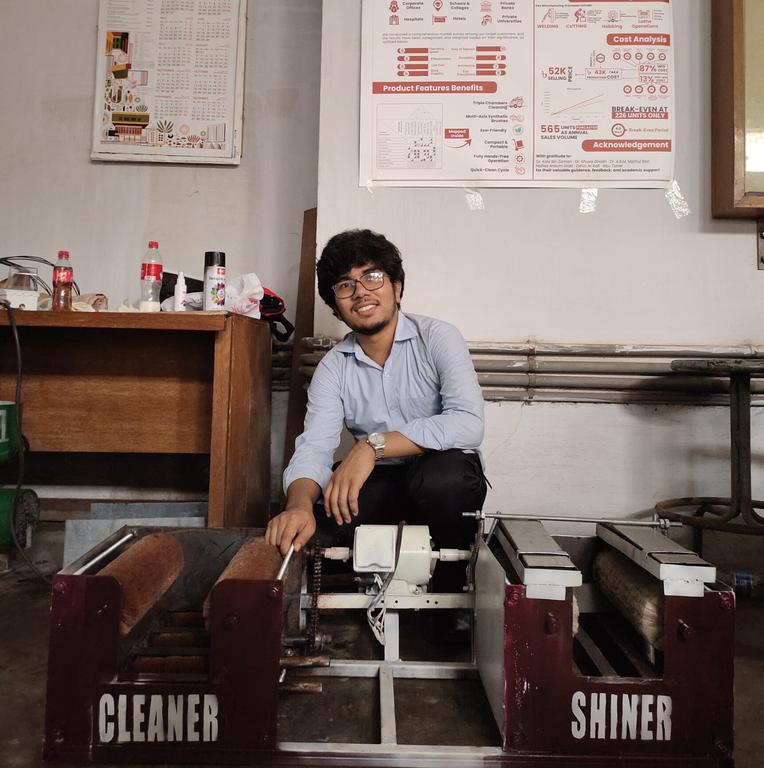
Shoe Shiner and Cleaner physical working prototype.
Manual shoe polishing is time-consuming, messy, and inconsistent. In commercial offices, hospitality venues, and residences, there is a clear demand for an automated, compact device that can clean, wax, and buff footwear rapidly without requiring the user to stoop or soil their hands.
As part of the Product Design I & II capstone sequence at BUET (Department of Industrial and Production Engineering), our team developed Shoe Shiner Pro: an automated electromechanical consumer appliance designed from first principles, refined through FEA simulation, and validated via a fully working physical prototype.
Mechanism Synthesis & Kinematics
The core engineering challenge was creating a compact mechanism capable of performing three distinct operations within a single compact footprint:
- Surface De-Dusting: Coarse synthetic bristle roller removing loose dirt and debris.
- Dispensing Cream/Polish: A cam-actuated valve mechanism delivering controlled micro-doses of cream polish onto the shoe surface.
- High-Speed Buffing & Polishing: Dual counter-rotating microfiber cylindrical pads delivering uniform friction buffing for an optimal gloss finish.
Parametric CAD Modeling in SolidWorks
We modeled the complete assembly in SolidWorks, focusing on Design for Manufacturing and Assembly (DFMA) principles:
CAD Subassembly Breakdown:
- • Ergonomic outer chassis with anti-slip footplate and debris capture drawer
- • Gearbox transmission converting motor output to dual roller shafts
- • Polish reservoir subassembly with spring-loaded plunger actuation
- • Internal electrical housing insulating motors and wiring from dust
Interference detection analyses were conducted in SolidWorks to verify clearance tolerances across all rotating joints and gear meshes prior to tooling.
Finite Element Structural Analysis in ANSYS
Because the device directly supports user foot pressure during operation, structural integrity was a critical requirement. We exported the chassis and footplate geometry to ANSYS Workbench for static structural stress analysis:
Von Mises Equivalent Stress Formulation:
Factor of Safety (FOS) Criterion:
- Loading Conditions: Applied vertical static downward forces up to $F = 1000\text{ N}$ (simulating heavy foot load) with fixed base boundary constraints.
- Mesh Generation: High-density tetrahedral mesh with local refinement around fillet zones and screw fastening points.
- Stress & Deflection Results: Maximum von Mises stress $\sigma_{\max}$ remained well below the yield strength $\sigma_{\text{yield}}$ of the selected engineering polymer, confirming an $\text{FOS} \gt 2.5$ with negligible deflection ($\delta \lt 0.4\text{ mm}$).
Fabrication & Prototype Testing
The prototype was physically constructed using high-torque DC gear motors, machined aluminum drive shafts, durable bristle cylinders, and safety interlock pressure switches that automatically stop roller rotation when the user's foot is removed.
Testing confirmed that the automated cycle cleans and polishes a shoe in under 30 seconds with zero polish splatter, fulfilling all original design targets.
Key Engineering Competencies
- Design & Simulation: SolidWorks 3D CAD, ANSYS Workbench (Static Structural FEA), DFMA
- Electromechanical Integration: Motor sizing, gear transmission, sensor-switched electrical safety circuits