Fanciful mundane anecdote of an egregious and pertenicious writer
A rich collection of historical and narrative vignettes spanning ancient bronze-age myths, Gutenberg's typography revolution, Cold War espionage, and engineering dilemmas.
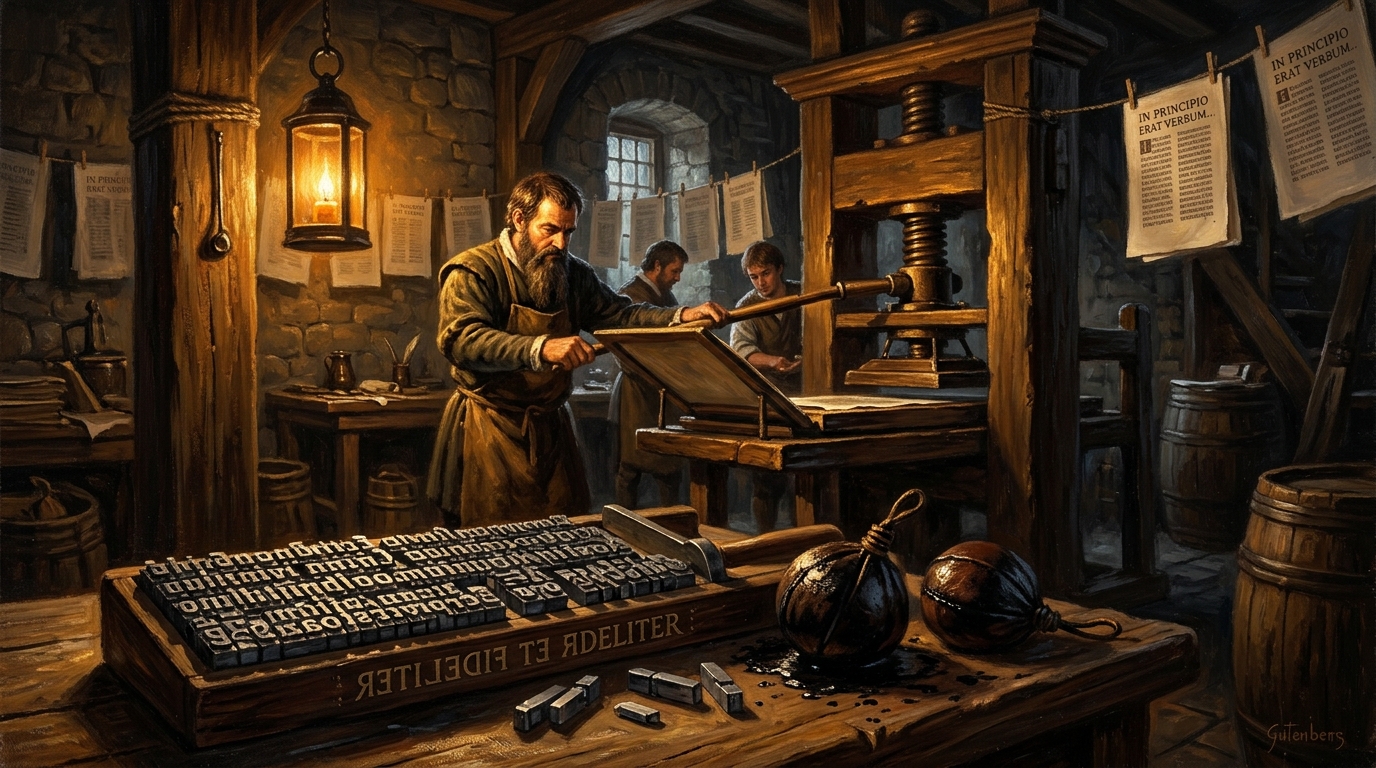
Johannes Gutenberg in his 15th-century Mainz workshop casting movable lead type.
Story One: The Blood Price of Asphodel

The Blood Price of Asphodel: An ethereal sacred stag stands in an asphodel meadow as the Mycenaean fleet waits in the mist
In the bronze age of Peloponnese, when Mycenaean kings still claimed descent from Zeus, the perilous and narrow strait of Salamis was bedeviled by a pervasive curse. Dark omens in the limpid coastal waters seemed to portend ruin for King Menelaus’s fractious fleet, which had grown sluggish and somnolent while awaiting favorable winds. Though a stoic commander of sharp tactical acumen, the king was surrounded by complacent and myopic advisors whose rudimentary grasp of sea lore could only hamper the voyage.
To expedite their departure, Menelaus summoned Calchas, an eccentric seer with a predilection for esoteric rites. The prophet was the exact antithesis of the boisterous, ostentatious Mycenaean warlords; he lived a spartan existence and chose to eschew royal gold. With a slow, provincial drawl, Calchas mocked the court’s sham piety and satirical ballads. He refused to offer perfunctory obeisance to the throne, nor would he feign a mawkish sympathy for the nobles who began to lament their stalled ambitions.
During a clandestine midnight council, while deliberating over a cumbersome bronze astrolabe, the pensive seer made a deliberate accusation. He claimed a furtive, rapacious chieftain had committed a seemingly slight offense: slaying a sacred stag in a meadow of pale asphodel blossoms. No salutary herb or earthly panacea could exculpate the fleet or preclude the goddess Artemis’s wrath.
The accused warlord, a truculent and churlish brute, tried to remain nonchalant and evasive, even attempting to avow that his captains were merely partial to hunting wild game. Yet the fastidious priest demanded a chivalrous sacrifice that would supersede all royal decrees. With his bowstring pulled taut, the king had no choice but to sever his alliance with the offending lord, taking no relish in the blood price required to make the wind indispensable to their sails blow once more.
Story Two: The Lead Alloy Awakening: Gutenberg, Typography, and the Death of the Medieval Information Monopoly
The Lead Alloy Awakening: Johannes Gutenberg composing movable lead type under warm lantern light in Mainz
For nearly a millennium following the collapse of the Western Roman Empire, the preservation of European knowledge rested within the quiet, vaulted chambers of monastic scriptoria. In these secluded enclaves, scribes labored over vellum and parchment, treating the act of copying texts as a sacred, almost numinous vocation. Yet as the fifteenth century dawned, this medieval system of information management had grown hopelessly lethargic and incapable of meeting the demands of a rapidly expanding society. Burgeoning urban centers, newly chartered universities, and a rising merchant class hungered for legal codes, scientific treatises, and vernacular literature. The hand-copying model was simply no longer tenable. Into this bottleneck stepped Johannes Gutenberg of Mainz, an inventor whose mechanical synthesis of movable metal type, oil-based ink, and the screw press ignited a tempestuous technological revolution—one that would permanently shatter the medieval monopoly on human thought.
Before Gutenberg’s breakthrough in the 1450s, acquiring a library was an onerous and prohibitively expensive endeavor. Monastic and guild copyists operated within a Byzantine network of patronage, ecclesiastical oversight, and rigid guild regulations. Furthermore, manual transcription was inherently flawed; a single tired scribe could accidentally vitiate the mathematical accuracy of an astronomical table or corrupt a line of Aristotelian philosophy, and subsequent copyists would faithfully perpetuate that exact error for generations. When rumors first circulated in Mainz of a machine that could multiply texts by the hundreds without a pen, traditionalists dismissed the notion as illusory. Wealthy patrons who prized illuminated manuscripts—with their baroque floral borders and gold-leaf flourishes—viewed the uniform, stamped pages of early printing presses with cavalier disdain. To a courtly sycophant eager to flatter a duke’s aesthetic vanity, a mechanically reproduced book was a vulgar, soulless object.
Gutenberg, however, possessed a canny understanding of metallurgy and precision engineering. Drawing from his background in goldsmithing and coin minting, he recognized that the true secret to mechanized writing lay not in the wooden press itself, but in the creation of an adjustable hand mold. By casting individual letters from a durable alloy of lead, tin, and antimony, he created typographic pieces that were completely interchangeable and, in an economic sense, entirely fungible. One lowercase Latin letter could replace another seamlessly across thousands of impressions. To convert raw metal and linseed soot into a credible rival to the finest calligraphy, Gutenberg had to mimic the dense, black Gothic script of fifteenth-century liturgical manuscripts. The result—the forty-two-line Bible—was an exhilarating triumph of early industrial standardization.
Despite the brilliance of his invention, Gutenberg’s personal business dealings proved disastrous. His partnership with the wealthy financier Johann Fust devolved into an acrimonious legal dispute over unpaid loans. Fust, far from being an altruistic patron of the arts, was a parsimonious creditor who demanded an exhaustive accounting of every guilder spent on ink, paper, and labor. Exasperated by Gutenberg’s slow production timeline and relentless perfectionism, Fust foreclosed on the workshop in 1455. While Gutenberg’s personal fortune began to dwindle, Fust and his skilled son-in-law, Peter Schöffer, transformed the confiscated press into a wildly lucrative commercial enterprise.
Within three decades, the typographic craft broke out of Mainz and began to diffuse rapidly along European trade routes, reaching Venice, Paris, Basel, and London. Once considered an obscure German metallurgy trick, movable type soon threatened to eclipse the traditional manuscript trade entirely. In Venice, the scholar-printer Aldus Manutius revolutionized the medium once more. Rejecting the heavy, verbose scholastic commentaries that cluttered medieval folios, Manutius stripped away extraneous margins and introduced compact, portable octavo editions set in a clean, pellucid italic typeface. Printing was no longer merely preserving the past; it was restructuring how the human mind organized information. Scholars with an affinity for classical antiquity could now compile encyclopedic reference works, cross-indexed botanical catalogs, and standardized anatomical diagrams that were previously impossible to reproduce accurately by hand. Yet this democratization of knowledge did not arrive as a purely beneficent force of peaceful enlightenment. By drastically lowering the cost of broadcasting ideas, the printing press acted as an accelerant for ideological warfare, serving to exacerbate long-simmering religious and political grievances. In 1517, when Martin Luther composed his Ninety-Five Theses in Wittenberg, the printing press transformed what might have remained a peripheral, academic dispute among Latin theologians into a continental firestorm. Within weeks, printers translated and multiplied Luther’s propositions across Germany.
The tone of public discourse shifted overnight. Early modern Europe became flooded with provocative broadsheets, woodcut caricatures, and scathing polemics. Reformers and Catholic apologists alike abandoned conciliatory dialogue in favor of belligerent pamphlet campaigns. Instead of hiding behind metaphorical allegories, dissident writers launched overt attacks against papal corruption and royal absolutism. Even a laconic slogan printed beneath a woodcut could ignite a peasant revolt, allowing illiterate laborers to grasp the rebellious message at a glance.
For the established hierarchy of Church and Crown, this unregulated flood of ink was an intolerable transgression. Ecclesiastical authorities refused to countenance a technology that allowed any disgruntled heretic with a few coins to challenge magisterial dogma. Determined to restore intellectual order, popes and monarchs established invidious systems of prior censorship, compiling the Index Librorum Prohibitorum (Index of Forbidden Books) and threatening rogue printers with public opprobrium, confiscation of property, or execution. Authorities demanded that accused heretics publicly renounce their printed works while standing before bonfires of their own pages.
Yet these royal decrees and papal bulls proved largely futile. The decentralized nature of the printing trade meant that whenever censors shut down a press in Paris or Antwerp, clandestine workshops in Geneva or Amsterdam simply printed double the run and smuggled the unbound sheets across borders in wine casks. No bishop could reach a lasting compromise with a machine designed for infinite replication. The revolutionary fervor of the Protestant Reformation and the subsequent Scientific Revolution was inextricably bound to the survival of these independent print shops.
Looking back through the documentary record of early modern Europe, the contrast between the pre-print and post-print eras appears almost incongruous in its speed and scale. It has become somewhat hackneyed among modern commentators to compare every new communications medium to Gutenberg’s workshop, often drawing superficial parallels between fifteenth-century movable type and twenty-first-century digital networks. However, a rigorously rational analysis of history confirms that the transition from script to print was no ordinary upgrade in efficiency. While distressed scribes lamented the loss of their craft, the lead alloy letters of Mainz permanently altered the architecture of human civilization—proving that once the machinery of mass literacy is set in motion, no earthly authority can put the words back into the inkwell.
Story Three: The Pelton Wheel Fallacy

The Pelton Wheel Fallacy: Miniature Pelton turbine wheel testing under high-pressure water spray in a nocturnal engineering laboratory
During the second-year fluid mechanics sessional at the university, Porter agreed to collaborate with Sara on building a miniature Pelton wheel turbine. Though naturally reticent, Porter felt an inborn affinity for her, disguising his romantic fervor behind an altruistic willingness to debug her MATLAB scripts at two in the morning. Their departmental advisor was an exacting professor whose stringent grading rubrics and astringent, scathing critiques left half the sophomores flummoxed. Yet working beside Sara beneath the flickering fluorescent lights of the machine shop felt exhilarating to Porter, shaking him out of his usual post-lecture torpor and lethargic routine. He was a competent and adroit CAD designer, always ready to amend a flawed impeller drawing or trim extraneous, diffuse paragraphs from their lab reports until the technical methodology was pellucid and exhaustive.
However, Sara’s attention had already drifted toward Chase, a self-styled campus polymath and versatile debater from their section. To Porter, Chase was an elitist showman who hid a superficial grasp of thermodynamics behind baroque vocabulary and a Byzantine web of excuses whenever group work was due. While Porter refused to deride Chase openly, he watched with quiet animus as Sara became an eager apologist for Chase’s wayward lab attendance. Whenever Chase offered a conciliatory smile or mimiced the professor’s quirks, Sara’s guarded countenance softened with overt admiration. During fluid lab hours, Porter began noticing subtle, surreptitious glances and covert text messages passing between them across the hydraulic bench—a tantalizing proximity that reminded Porter how divorced his rational engineering mind was from the mechanics of her heart.
The breaking point arrived on the afternoon of the final pump-efficiency demonstration. Sara asked if they could add Chase’s name to their documentary data sheet so he wouldn't fail the sessional—a compromise that felt tantamount to erasing Porter’s sleepless weeks in the workshop. Taking quiet umbrage at the request, Porter realized he had allowed himself to become entirely subservient to her wishes, acting as a discreet academic safety net while she chased another classmate. Still, unable to bear her anxious expression, he chose to acquiesce to the invidious arrangement without a word of protest.
That evening, standing outside the mechanical annex as autumn rain blurred the campus streetlights, Porter finally confronted the illusory nature of his devotion. Any credible hope that his fruitful engineering partnership with Sara would correlate to romance was utterly futile. There was no numinous destiny waiting to reward his silent loyalty, nor could any trenchant equation dictate who she chose to love. Refusing to perpetuate his own heartbreak around an obscure, metaphorical dream, Porter handed Sara the bound project report, wished her and Chase well, and walked back to his dorm hall alone.
Story Four: The Cipher of Sector Four
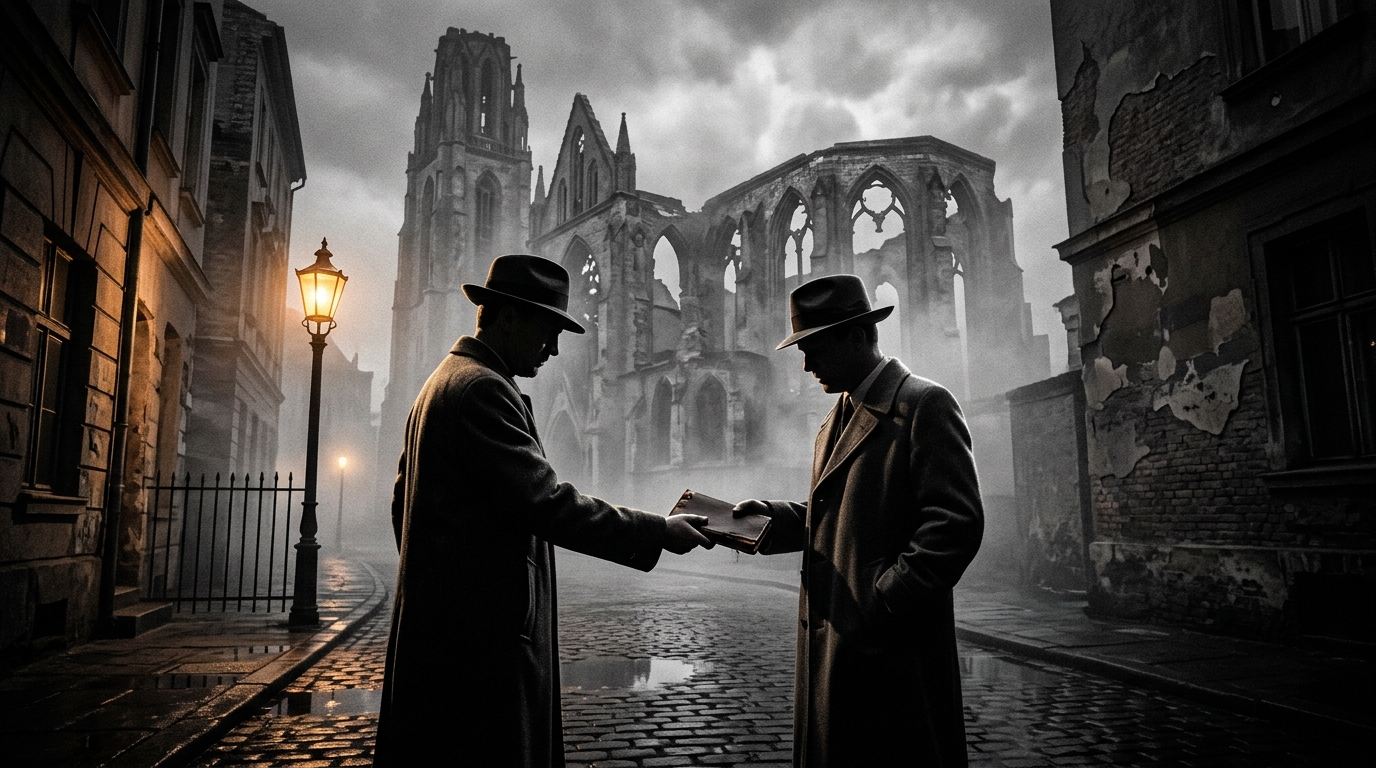
The Cipher of Sector Four: Secret rendezvous in the 1961 Tiergarten fog of divided Berlin near the ruins of a cathedral
In the winter of 1961, behind the heavy velvet curtain of divided Berlin—where orders to curtail border crossings had just been finalized—cryptographer Viktor Mahler worked inside a windowless listening post. His task was to elucidate an inscrutable Soviet one-time pad whose mathematical structure seemed to antedate modern computer ciphers. While his feckless superiors wallowed in bureaucratic apathy and monotonous committee meetings, Viktor remained thorough and judicious. He refused to let the entrenched orthodoxy of the agency inhibit his iconoclastic methods. For months, he had chosen to immure himself in the basement vault to ruminate over peculiar frequency anomalies and refine a synoptic overview of Warsaw Pact transmissions. Though his divergent theories threatened to alienate him from the directorate’s consensus, a lucid breakthrough finally left him quietly elated.
The intercepted cables exposed "Vesper," a sophisticated double agent operating under the cloak of a West German trade attaché. Publicly, Western officials chose to lionize the attaché as a visionary diplomat of impeccable propriety and understated charm, allowing him to enchant high-society salons with exotic tales and the sheer scintillation of his wit. In reality, he was an unscrupulous, profligate operative whose exploitative network thrived on ideological strife. Apropos of the upcoming Geneva summit, Vesper had begun to premeditate a sensational betrayal that would violate every allied security protocol in an already volatile sector. To gratify his Moscow handlers, he intended to distort NATO radar assessments and forsake three field couriers to certain execution.
When Viktor presented pertinent proof of the mole’s virulent treason, the station chief began to bridle with defensive rage. Vociferous counterintelligence deputies questioned the veracity of the decrypted logs, apt to protect their prized asset rather than heed a basement analyst's warning. Ordered to comply with a gag directive, relinquish his notebooks, and banish all suspicion of the attaché for the foreseeable future, Viktor stood crestfallen. He realized that letting this bureaucratic rot fester while trying to reconcile the agency's recondite political games with his conscience would cost lives.
That night, stripping away all superfluous caution, Viktor decided to improvise a daring extraction in the Tiergarten fog. Meeting a skittish field courier beside a bombed-out cathedral, he handed over the raw cipher key so the doomed operatives could evade the KGB trap before dawn.
Story Five: The Separation Gap on Valve Three

The Separation Gap on Valve Three: NASA failure analysis cleanroom investigation of the Space Shuttle hydrogen flow control valve
In December 2008, after Space Shuttle Endeavour returned from STS-126 with an erratic pressure signature in its main propulsion system, NASA propulsion engineer Bill Gerstenmaier had to ascertain why a tiny gaseous hydrogen flow control valve had failed. While acquisitive defense contractors and sanctimonious bureau chiefs offered tepid, prolix briefings to deflect blame, Gerstenmaier held a deep aversion to bogus assurances. He refused to discount the predicament or abet a foolhardy rush to launch the next orbiter, knowing a fractured titanium poppet could rupture a cryogenic line and trigger a cataclysmic explosion. Treating the anomaly as a veritable crisis rather than a subordinate maintenance issue, he gathered an industrious, proficient failure-analysis team in Huntsville to inspect the barely accessible internal lip of the valve.
Initial vendor memos were disingenuous, claiming the pressure spike was caused by a fallacious sensor reading or a solenoid glitch. During a contentious teleconference, a petulant, dogmatic contractor tried to impugn the lab technicians and upbraid a dissident metallurgist for raising irksome questions that might tarnish the company’s patent on the valve assembly. Gerstenmaier felt open scorn and contempt for such unseemly, blithe arrogance. With assertive authority and a pithy rebuttal, he noted that a scanning electron microscope had already exposed a pernicious fatigue crack along the valve’s separation gap. Any inveterate tendency to hinder the inquiry or circumscribe testing budgets to a miserly sum would impair crew safety and wrap a burocratic manacle around sound engineering.
Refusing to dawdle amid the vexation of launch delays, Gerstenmaier’s team worked through incessant shifts in a lab purged of noxious solvents to amalgamate inspection data from prior flights. By firing high-velocity test particles at seven hundred feet per second through steel elbows and polishing valve edges with diamond dust on a lathe, they generated four thousand microscopic images to inform their model. The complementary stress tests proved how acoustic vibrations could augment metal fatigue, allowing the team to design an efficacious dye-penetrant screening and notch-load protocol to attenuate the risk of poppet liberation.
Though naturally modest and never inclined to divulge his own exhausting hours or seek public acclaim, Gerstenmaier presented an equitable, data-driven flight rationale that safely cleared Space Shuttle Discovery for launch.
For a deeper look at how engineers diagnosed and solved another famous mechanical flaw in NASA's rocket propulsion history, watch The Saturn V's Weakest Link: How Engineers Solved Its Biggest Flaw.
Story Six: Bread, Roses, and the Looms of Lawrence
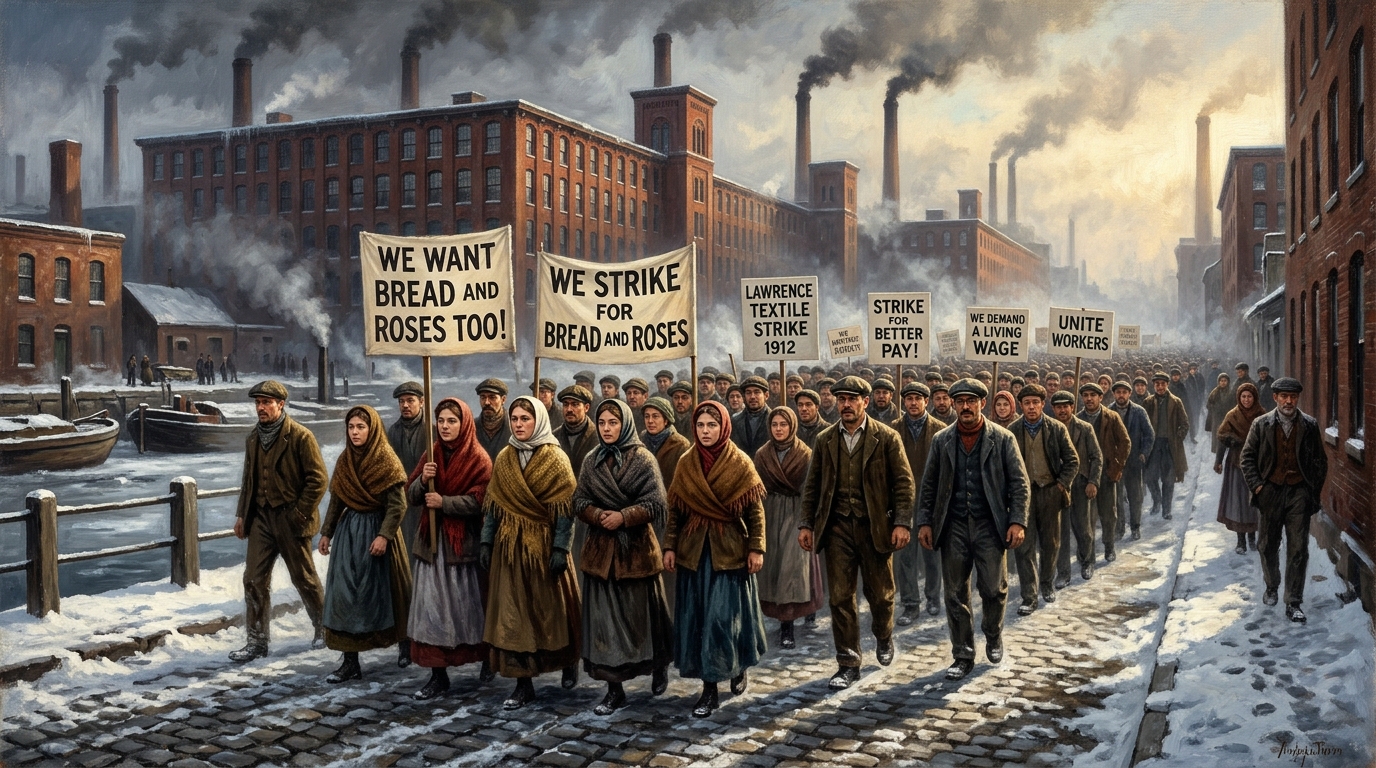
Bread, Roses, and the Looms of Lawrence: Striking textile workers marching through snow past Lawrence woolen mills with Bread and Roses banners
In January 1912, when a new Massachusetts labor law reduced the maximum workweek for women and children from fifty-six to fifty-four hours, William Wood—president of the American Woolen Company—used the statute as a base and expedient excuse to cut the weekly wages of thirty thousand immigrant weavers. To the mill barons, deducting three loaves of bread worth of pay was a minute, pedestrian ledger adjustment. Yet for glum families already enduring woeful tenement conditions and perennial malnutrition, this discrepancy in their pay envelopes was a matter of survival. For years, pious corporate philanthropists had touted their munificent civic largess while using duplicitous bookkeeping to conceal official malfeasance and coercion on the factory floor. When naive, gawky Polish and Italian loom-tenders opened their shorted envelopes on January 11, they refused to supplicate before the foremen; instead, they shut down the machinery, turning a local grievance into the harbinger of a radical industrial awakening.
Fearful of a nascent worker uprising, the parochial city council and mill owners tried to inveigle conservative craft unions into creating a schism along ethnic lines. Corporate publicists worked to fabricate evidence—planting sticks of dynamite in a cobbler’s shop—to slander the strikers as anarchists, while florid newspaper editorials launched a tirade against foreign agitators. When summoned before investigators, mill executives chose to prevaricate with mendacity and cunning, offering facetious remarks about how workers spent their wages like modish libertines. Yet the arrival of stalwart Industrial Workers of the World organizers like Joseph Ettor and the ebullient orator Arturo Giovannitti helped vanquish despair. Standing abreast on icy picket lines across twenty languages, the strikers proved that solidarity was not a transitory mood, but an intrinsic, universal bond.
To discomfort (discomfit) the state militia and keep national newspapers abreast of the crisis, fiery twenty-one-year-old organizer Elizabeth Gurley Flynn—hardly a passive acolyte—decided to jettison cautious diplomacy. Recognizing that even the bravest picket line was fallible against starvation and bayonets, she arranged a providential exodus: sending hundreds of strikers' children to foster families in New York. When city police brutally beat mothers and children at the Lawrence train station to block a subsequent departure, the manifest cruelty served to confound the mill owners' dubious public relations campaign.
Summoned to Washington, teenage mill worker Camella Teoli testified before Congress without a single digression, delivering a terse account of how a twisting machine had torn her scalp off in the factory. Her prowess on the witness stand helped distill the moral core of the strike, inspiring writers to coin the movement the "Bread and Roses" strike—a demand for both temporal survival and noble human dignity. By March, unable to anoint a viable replacement workforce or crush the dissent before a recrudescence of spring protests, the textile trust capitulated, granting raises to a quarter-million workers across New England.
Story Seven: The Iron Ravens of Sicily
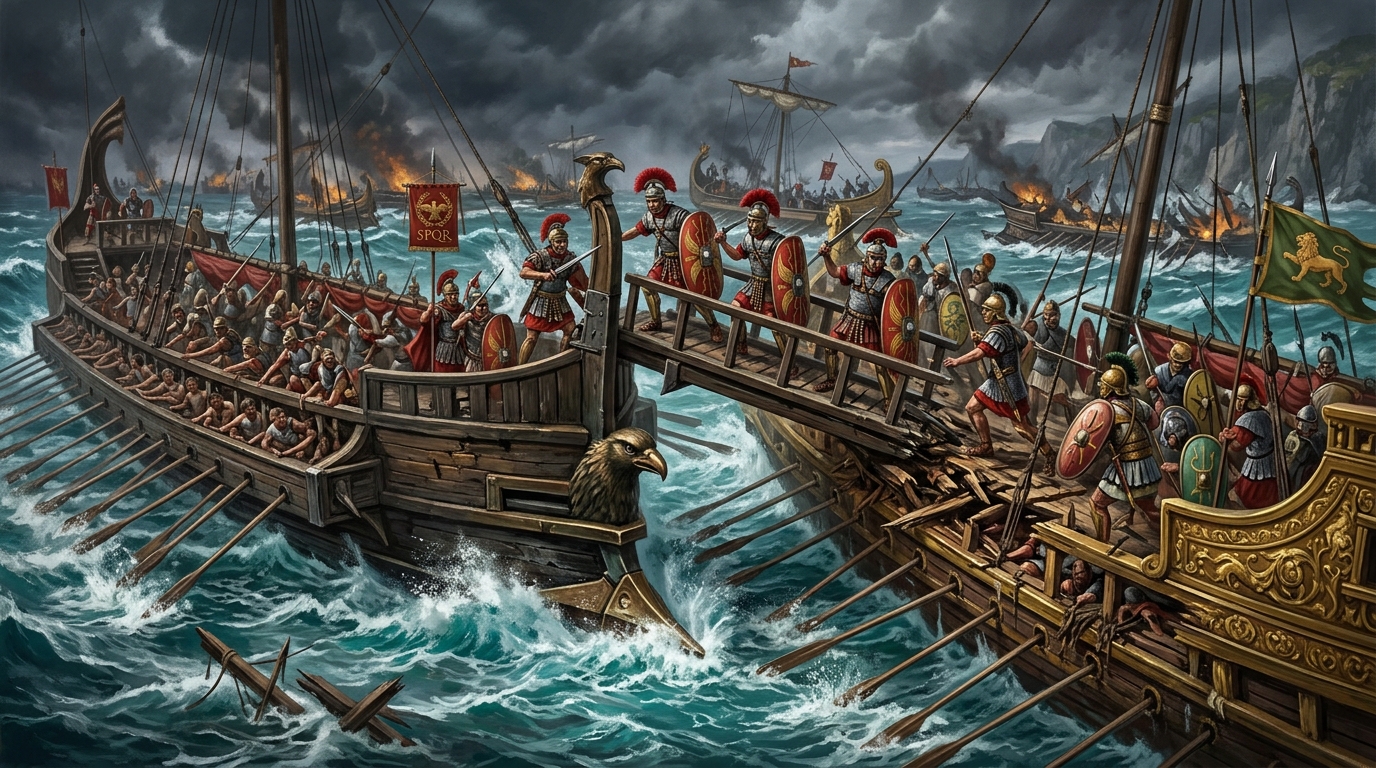
The Iron Ravens of Sicily: The Roman Corvus boarding bridge crashing down on a Carthaginian galley at the Battle of Cape Ecnomus
In 264 BCE, an imminent clash over the strategic straits of Messina plunged the Mediterranean into an unprecedented war. For generations, Carthage had ruled the waves with prodigidous maritime experience, leaving Rome’s fledgling naval forces at a severe disadvantage. Yet the Roman Senate remained resolute, refusing to accept a stinting peace or let Mediterranean trade routes stay inviolate to Punic control. To extrapolate a path to victory, Roman shipwrights engineered a cumbersome yet revolutionary boarding bridge known as the corvus—a supple mechanism designed to drop like an iron claw onto enemy decks. This device would render Carthaginian naval superiority obsolete by transforming complex sea maneuvers into elementary infantry combat.
At the colossal Battle of Cape Ecnomus in 256 BCE, this painstaking tactic faced its ultimate trial. As hundreds of galleys collided in an arresting display of martial fury, the corvus clamped onto Punic hulls with prodigious force, allowing Roman legionaries to demonstrate their legendary valor in hand-to-hand combat. The euphoric victory opened a maritime corridor, enabling Consul Marcus Atilius Regulus to lead an itinerant expeditionary force across the sea. Initially, the campaign in Africa was meritorious, moving with fortitude past initial fortifications. However, Regulus grew overconfident, letting a fervent ambition foment strategic errors. He offered stinting, arrogant terms, attempting to goad Carthage into abject surrender.
Instead of an amicable capitulation, Regulus suffered a catastrophic reverse when Spartan mercenary commander Xanthippus deployed war elephants and cavalry that shattered the Roman lines. Captured in the debacle, Regulus became a tragic liability to his homeland, while the remaining Roman survivors faced a barrage of storms and logistical disasters. For years, the conflict degenerated into a tentative, grinding stalemate across the rugged hills of Sicily. Punic generals tried to falter Rome's resolve through heterodox guerrilla tactics, but the Republic proved remarkably resilient. Whenever political leadership showed signs of a qualm or tried to renege on war funding, the citizen assemblies would chastise the hesitant and empyrean leaders.
By 241 BCE, after twenty-three years of incessant suffering, Rome scraped together one final, tax-funded fleet under Gaius Lutatius Catulus. This fortuitous armada caught the undermanned Carthaginian supply ships off the Aegates Islands by surprise. The resulting victory was incontrovertible. Exhausted by economic drain and structural animosity, Carthage finally had to dispense with its imperial ambitions in the region, signing a treaty that ceded Sicily to Rome and brought a cathartic close to the grueling war.
Md. Muqtadir Fuad is a graduate in Industrial and Production Engineering from BUET, conducting research at the intersection of Operations Research, Machine Learning, and Social Impact.